At Leadgate Primary School, we believe every child deserves an education that prepares them not only for academic success but also to flourish as confident, healthy and respectful individuals in modern society. Personal, Social, Health and Economic (PSHE) education, including Relationships and Sex Education (RSE), sits at the heart of this commitment.
PSHE is not an add‑on to our curriculum; it is fundamental to children’s development and wellbeing. Through high‑quality PSHE, we equip pupils with the knowledge, skills and attributes they need to stay safe, look after their mental and physical health, and form positive, respectful relationships throughout their lives.
Our PSHE curriculum is developmental and progressive. From the moment children join our school, they begin learning about emotional literacy—recognising, naming and talking about feelings. This foundation is built upon year by year, enabling pupils to develop resilience, manage emotions effectively, and make informed decisions that support their own wellbeing and that of others.
By embedding PSHE across our school culture, we nurture a community where respect, inclusion and responsibility flourish. In doing so, we prepare our pupils not only for the challenges of childhood, but also for adolescence, adulthood, work and active citizenship.
We are committed to:
- Supporting the whole child — recognising that children’s emotional and social development directly impacts their ability to learn
- Creating a safe, inclusive environment where every child feels valued and confident to share concerns without fear or stigma
- Building strong foundations for the future through age‑appropriate learning that prepares children for the challenges and opportunities ahead
- Working in partnership with families, recognising that parents and carers are children’s first educators in many aspects of relationships and health
- Embedding PSHE across school life, not just in planned lessons but through our values, relationships and everyday interactions
The Jigsaw Approach: A Whole‑School Framework
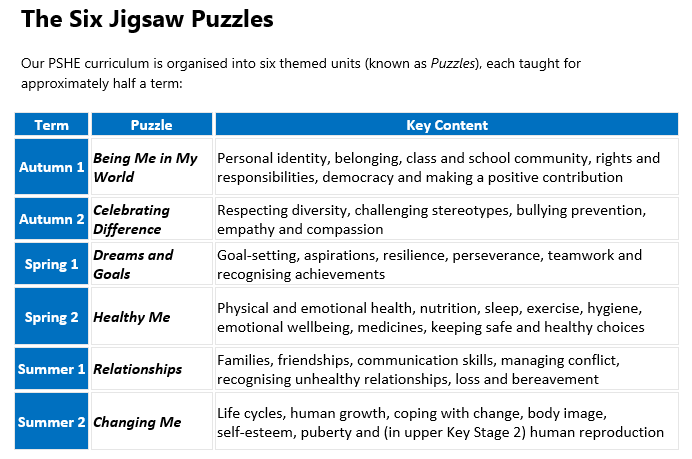
We deliver our PSHE and RSE curriculum through the Jigsaw PSHE Programme. Jigsaw provides a comprehensive, carefully sequenced scheme of work that ensures consistency, progression and high standards across the primary years. It is built on current research and best practice in child development, safeguarding and health education, and is regularly updated in line with statutory guidance.
The programme is particularly effective because of its distinctive approach:
Emotional Literacy at the Core
Every Jigsaw lesson explicitly develops children’s emotional vocabulary and understanding. Pupils learn to recognise, name and discuss a wide range of feelings in themselves and others, enabling them to seek help when they need it and to build positive relationships.
Mindful Practice
Each lesson begins with Calm Me Time—a short, age‑appropriate mindfulness activity. This supports self‑regulation and creates a calm, safe and focused environment for learning and discussion.
Connection and Community
The Connect Us activity builds strong relationships within the class, promoting a sense of belonging, mutual respect and shared responsibility. These social skills underpin learning across the curriculum.
Developing Skills for Respectful Dialogue
PSHE lessons provide regular opportunities for children to practise listening, expressing their views respectfully, considering different perspectives and engaging in constructive discussion. These oracy skills help children to navigate differences with empathy and confidence.
An Age‑Appropriate Spiral Curriculum
Key themes are revisited each year with increasing depth and complexity, allowing children to build on prior learning as their understanding and maturity develop. Teachers adapt lessons to meet the needs of their pupils.
Interactive and Participative Learning
Lessons are engaging and active, using discussion, role‑play, problem‑solving and creative activities. Children do not simply receive information; they develop practical skills that support them in real‑life situations.